Forex Trading for Beginners
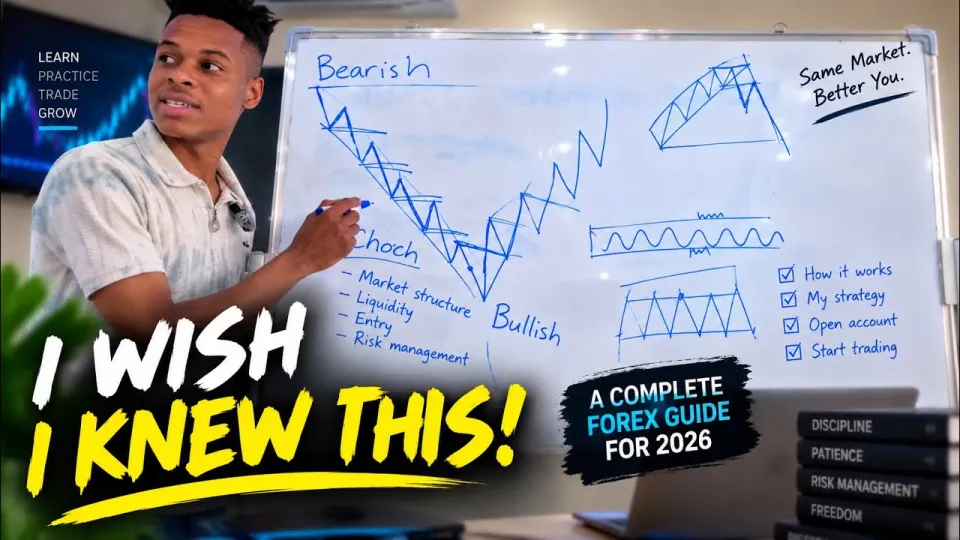
Video: How To Start Forex Trading For Beginners in 2026 (Full Guide + My Strategy)
Want articles like this for your own video to promote it on YouTube and Google? Order them through the Telegram bot @sat_sit_bot. The bot writes and publishes the articles itself (with your YouTube video embedded) on popular topical websites (no ads). Free trial — 50 articles.
· based on the channel Carl Fx
Key takeaways
- Forex is a decentralized over-the-counter market where currencies trade in pairs; there is no single exchange.
- The most liquid session overlap is London–New York, roughly 13:00–16:00 UTC.
- A demo account lets you test a strategy without risking real money.
- Risking 1% or less per trade is a common rule for surviving a losing streak.
- Market structure — higher highs and higher lows versus lower highs and lower lows — frames most price-action strategies.
Forex trading for beginners starts with understanding that currencies are quoted in pairs and that most retail trading happens through a broker, not on a central exchange. You open an account, learn to read market structure and price action, and practise a simple strategy on a demo before risking real money. The guide below walks through that sequence step by step, and you can open a live account through TFC Global Markets registration when you are ready to trade.
How the forex market actually works
The forex market is a global, decentralized network of banks, brokers and retail traders where currencies are exchanged in pairs. There is no single exchange like a stock market; prices come from liquidity providers and are streamed to brokers, which is why quotes can differ slightly between platforms.
Currencies always trade in pairs: EUR/USD, GBP/USD, USD/JPY and similar. The first currency is the base and the second is the quote, so a EUR/USD price of 1.0850 means one euro buys 1.0850 US dollars. Retail traders usually speculate on whether the base currency will strengthen or weaken against the quote currency.
Liquidity is not constant. The busiest window is the overlap between the London and New York sessions, roughly 13:00–16:00 UTC, when spreads are typically tightest and moves are most active. Asian session ranges are often narrower, which matters for stop placement and position sizing.
Leverage is the feature that makes forex accessible and dangerous at the same time. A broker may offer leverage of 1:30, 1:100 or more, meaning a small deposit controls a much larger position. The risk is not the leverage itself but the position size it allows: a 1% move on a 1:100 position wipes out the account.
Getting started from zero: a step-by-step path
Starting from zero means building the account and the skill set in the right order rather than funding a live account on day one. The sequence below is the practical path most beginners follow.
- Choose a regulated broker and open a demo account. Check the regulator, the spreads on major pairs and the platform (MetaTrader 4/5 or a web terminal).
- Learn the platform: place market and pending orders, set stop-loss and take-profit, and read the account statement.
- Study one pair, such as EUR/USD, until you recognise its typical daily range and session behaviour.
- Practise a single strategy on demo for at least a few weeks and log every trade.
- Only after consistent demo results, open a live account with a small deposit and keep risk per trade at 1% or less.
The account-opening step is where many beginners stall. A straightforward route is the TFC Global Markets sign-up page, which is the broker linked in the Carl Fx guide; complete the registration, verify your identity and start on demo before switching to live.
Reading bullish and bearish markets with market structure
Market structure is the skeleton of price action: it tells you whether buyers or sellers are in control. In a bullish market, price makes higher highs and higher lows; in a bearish market, it makes lower highs and lower lows. When that pattern breaks — for example, a bullish sequence fails to make a new high and then breaks the last higher low — the structure is shifting.
A simple way to use this:
- Mark the most recent swing highs and swing lows on the higher timeframe, such as the 4-hour or daily chart.
- Label the trend: rising structure favours long setups, falling structure favours shorts.
- Wait for price to pull back to a previous swing level or a supply/demand zone rather than chasing the move.
- Enter only when the lower timeframe confirms the same direction, for example with a break of structure or a rejection candle.
This is the core of price-action trading: you are not predicting, you are reacting to what the chart has already printed. Beginners often skip this step and trade indicators alone, which is why their entries feel random.
A simple beginner strategy to practise
The strategy below is a basic trend-following pullback model that suits beginners because it uses only structure, a zone and a stop. It is not a guarantee of profit; it is a repeatable process you can test.
- On the 4-hour chart, identify the trend using swing highs and lows.
- Mark the last demand zone in an uptrend or supply zone in a downtrend.
- Drop to the 15-minute chart and wait for price to reach the zone.
- Look for a confirmation signal: a break of structure in the trend direction or a strong rejection candle.
- Place the stop-loss beyond the zone and set a target at the previous swing high or at least 1.5–2 times the risk.
- Risk no more than 1% of the account per trade and log the result.
Run this on demo for 30–50 trades before judging it. A small sample tells you nothing; the point is to see whether the rules produce a positive expectancy after spreads and commissions.
Common beginner mistakes and viewer questions
Most beginner losses come from process errors, not from bad analysis. The questions viewers raise under beginner guides tend to repeat the same themes: how to move from demo to live, why a strategy feels hard to grasp, and what to do when account opening is complicated.
- Jumping to live too early. A demo account removes emotion; a live account with real money exposes position sizing errors immediately. Trade small when you switch.
- Over-leveraging. Using maximum leverage on every trade turns a normal losing streak into a blown account. Size positions from the stop distance, not from the margin available.
- Strategy hopping. Switching systems after three losses prevents you from ever measuring a strategy. Pick one model and collect data.
- Ignoring the news. Central-bank decisions and inflation releases can gap the market through stops; check the economic calendar before entering.
- No trade log. Without records you cannot tell whether the strategy or the execution is the problem.
If a concept feels hard to grasp, reduce the chart to one pair and one timeframe for a week. Complexity is usually a sign of too many inputs, not too little knowledge.
Managing risk before chasing returns
Risk management is the part of forex trading that keeps you in the game long enough to learn. A beginner who risks 1% per trade can survive a run of ten losses with roughly a 10% drawdown; one who risks 10% per trade is down about 65% over the same streak and needs a 185% gain just to recover.
Practical rules:
- Set the stop-loss before entering, based on structure, not on how much you are willing to lose.
- Calculate lot size from the stop distance and the 1% risk limit.
- Cap daily losses, for example at 3%, and stop trading for the day when hit.
- Avoid trading during major news if your strategy is not designed for volatility.
- Withdraw part of profits regularly so that trading capital stays separate from living money.
Useful links
- Open a trading account with TFC Global Markets — the broker sign-up link from the Carl Fx guide.
- Carl Fx Telegram community — the free community channel mentioned in the video.
Final thoughts on starting forex trading
Forex trading for beginners is a skill-building process: understand the pair mechanics, open a demo account, learn market structure, and practise one simple strategy with strict risk control. The Carl Fx full guide covers this same foundation, and the broker link above is the account route referenced in it. Progress comes from logged trades and consistent rules, not from a single big win. Treat the first months as tuition, keep risk small, and only scale when the data supports it.
Questions & answers
How much money do I need to start forex trading?
You can open a live account with a small deposit, often as little as $50–$100 at many brokers, but the amount matters less than position sizing. With 1% risk per trade, a $100 account risks $1 per trade, which limits you to micro lots. Many beginners start on demo and fund a live account only after a few months of consistent practice.
Is forex trading profitable for beginners?
Most beginners lose money in their first months because they oversize positions and switch strategies too often. Profitability comes from a tested strategy, a trade log and strict risk limits, not from a lucky streak. Treat early trading as practice and judge results over at least 50–100 trades.
How long should I stay on a demo account?
Stay on demo until you can follow your rules for 30–50 trades without breaking them and your results show a positive expectancy after spreads. Some traders need a few weeks, others several months. Moving to live too early usually exposes emotional mistakes that demo cannot simulate.
What is market structure in forex?
Market structure is the pattern of swing highs and swing lows that shows whether buyers or sellers control price. Higher highs and higher lows indicate a bullish trend; lower highs and lower lows indicate a bearish trend. A break of that pattern signals a possible shift and is a common basis for entry confirmation.
Source: How To Start Forex Trading For Beginners in 2026 (Full Guide + My Strategy) · Markdown version